It is clear from Jewish scripture that God expects the human conscience to be able to distinguish between worship of God, and idolatry. Time and time again, the prophets appeal to human logic, and sometimes even to human humor in order to demonstrate the evil of idolatry.

Sunday, August 22, 2021

The Great Tzitzit Controversy


The Great Tzitzit Controversy


There is a small but growing number of people in the very messy Messianic movement that have begun tying tzitzit on the belt loops? [1]
"Hanging tzitzit from belt loops (which may seem ‘cool’ or ‘hip’) is no fulfillment of the commandment according to its plain meaning and therefore is an idle act." 

The Great Tzitzit Controversy


By Philip Crossan


Hear I go again writing about yet another touchy subject. But it is a subject worth addressing. There is a small but growing number of people in the very messy Messianic movement that have begun tying tzitzit on the belt loops of their pants and wearing them on Sabbath. Maybe that is alright if one really feels that this is something they should be doing. I do respect my friends who do this and I likewise appreciate their willingness to obey the Scriptures. But I’m not so sure they grasp the entire commandment. I suppose what really got the ball rolling around in my head concerning this issue is when being confronted by those who feel their personal interpretation of the commandment is something to split fellowship over. In this study we will be looking at what the Bible says and attempting to decipher how we can apply it.

Numbers 15:38-40
(38) Speak unto the children of Israel, and bid them that they make them fringes in the borders of their garments throughout their generations, and that they put upon the fringe of the borders a ribband of blue:
(39) And it shall be unto you for a fringe, that ye may look upon it, and remember all the commandments of the LORD, and do them; and that ye seek not after your own heart and your own eyes, after which ye use to go a whoring:
  1. That ye may remember, and do all my commandments, and be holy unto your God.

Numbers 15:38 
38 'Speak unto the children of Israel, and bid them that they make them throughout their generations fringes in the corners of their garments, and that they put with the fringe of each corner a thread of blue. 


39 And it shall be unto you for a fringe, that ye may look upon it, and remember all the commandments of the LORD, and do them; and that ye go not about after your own heart and your own eyes, after which ye use to go astray; 


40 that ye may remember and do all My commandments, and be holy unto your God.    Listen to this Chapter in Hebrew 


First off in verse 38 we are presented with the word fringes, ציצת Tzitzit, a literal translation of the word is ‘fringe’ or ‘feather like’. But is the modern rabbinic tzitzit ‘feather like’? No not at all. Is the modern rabbinic tzitzit what is being described in the verse? I doubt it. Actually the modern rabbinic tzitzit came from what was developed in the late second temple period. The truth is that we do not know what the tzitzit from the time of Moses to the second temple actually looked like. Am I downplaying the modern tzitzit or telling you it is irrelevant? No not in any way. I wear them to you know and I don’t want to look like a big contradiction. I’m simply pointing out that the modern rabbinic tzitzit is probably not what the ancient Israelites wore. So don’t try to split theological hairs about it. But if this is not exactly what ancient Israel wore then why would we wear it. Simple, because it is the closest thing we have and it is generally accepted by the people of Israel. For those readers who do not realize that there are other forms of tzitzit then I suggest doing an internet search. For one example look up Karaite tzitzit for an interesting and different interpretation.

Our second point, also in verse 38, “in the borders of their garments”. Borders? ףנכ kanaf, literally means ‘corners’. The verse is actually referring to a ‘four cornered garment’. So there is to be four tzitzit and four corners upon which to tie them. Are belt loops corners? Do pants have corners? No and no again. The historic interpretation of this verse is the katan, a type of tunic or long shirt having four corners. Another innovation of the late second temple period is the tallit. The tallit appears to have been developed primarily by Jews outside of the land of Israel as an alternative to the traditional katan. The purpose of the tallit may have been that the garment can be put on or taken off anytime without changing ones actual outer garment unlike the katan. One last comment on the four corners, if a garment does not have four corners then it does not have to have tzitzit tied upon it, and probably should not.

Point number three “a ribband of blue”. The verse does not say what shade of blue nor how to make the specific dye. It is irrelevant, obeying the commandment with what is available is much more important than knowing the exact coloring process used by ancient Israel. If the exact process is available then glory be to HaShem (blessed be His name) and use it but the commandment is simply to use a ribband of blue. Therefore use what you have available.

Also take note that the verses do not say that the four cornered garment cannot be tucked into your pants. It likewise does not indicate length or thickness of the tzitzit, and says nothing about tzitzit and skin contact.

Let’s review what the commandment actually communicates. We are to wear a feather like fringe with a cord of blue on the corners of a four cornered garment. It is a sign for us to look upon not necessarily for others to look upon. This will serve as a reminder of the commandments.

Here are some serious considerations about the practicality of wearing tzitzit all the time or on the outside of clothing regularly. How about working with equipment? Think about the dangers of operating a drill press or table saw and getting religiously long tzitzit caught in the machine. How about a chainsaw, tractor, or tiller? More simply what about when weeding the garden or working on the vehicle. I’ll add to that the difficulty in cleaning them and making new ones so often. And here’s a real simple problem that everyone men and women face; how about using the toilet. The fact is long tzitzit might go where they should not. Let’s keep this simple brothers and sisters. HaShem (blessed be His name) did not give us burdensome commandments. He meant them to be good for us. There are many times that tzitzit are simply impractical, so don’t wear them at those times.


Editors Note: The name has been edited in italics above.

Because the Transcendent Name is so Sacred Jews traditionally use one of two titles rather than write or pronounce the Name needlessly. This is done to honor the Sacred Name (not out of superstition against using it as some critics imagine).


שמע ישראל ה 'הוא האלוהים שלנו הוא אחד

Shema Yisrael Adonai Elohaynu Adonai Echad
"Hear Israel, Adonai is our God, Adonai is One"


Tzitzit 
by Rabbi Shraga Simmons 

How to gain some meta-physical "fringe" benefits.

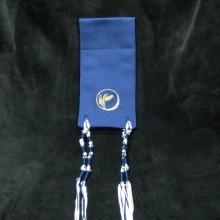
Tzitzit are tassels that hang down from the four corners of a rectangular garment, as the Torah says: "You shall put fringes on your four-cornered garment."1
Why do we wear Tzitzit? The Torah explains that by doing so, "you will see it and remember all the mitzvot."2
How do the tzitzit remind us of the mitzvot? On the simple level, Tzitzit serve as the colloquial string-around-the-finger reminder.3 As we go about our daily chores, whether at work or at a ball game, Tzitzit give us an anchor to the world of spirituality.
Further, the numerical value of "Tzitzit" is 600. Add to that the 8 strings and 5 knots on each corner, and you get 613 -- the number of mitzvot in the Torah.4
Let's delve a bit deeper into the verse: "You will see it and remember all the mitzvot." If there are four strings on each corner, why does the Torah use the singular form "it"?

"It" refers to the single blue thread on each corner prescribed by the Torah.5 The color blue is similar to the sea, which is like the clear blue sky, which is the color of God's "heavenly throne."6

Our challenge is to make spirituality a part of daily reality. In seeing the Tzitzit, we have a tangible reminder of an incorporeal God.7 Seeing God in our lives is a progression -- from recognizing his presence in mundane things like a garment, all the way to the spiritual realms ("heavenly throne").
In this way, Tzitzit has a meta-physical "fringe" benefit (pun intended), in helping to safeguard one from temptation.8 The Torah tells us: "And you will see them, and remember not to follow after your heart and eyes, that you stray after them."9 Tzitzit remind us that God is watching, and our actions should reflect that realization.

The Talmud10 tells of a man who was intensely addicted to a dangerous vice and was willing to spend any amount of money to satisfy that desire. One time he traveled across the world, and at the moment before the forbidden activity, the man's Tzitzit "slapped him in the face." The commentators11 explain that the Tzitzit struck him not literally, but psychologically -- with the four corners appearing as witnesses against him.

The Strings
On each corner, four strings are looped through a hole, and drape down on both sides, giving the appearance of eight tassels per corner.12 The upper one-third of the tassels are a series of five double-knots, separated one from another with four sets of windings. Below the bottom knot, the remaining two-thirds of each string hangs loosely.13
Each section of knots-and-windings should be approximately one inch (2.5 cm.) -- for a total of 4 inches of knots-and-windings, and 8 inches of loose hanging strings.
The hole on each corner should be about two inches from the edge,14 to fulfill the biblical requirement that it be on the garment's "corner." If the corner tears, it can usually be repaired.15
The strings must be made either from wool, or from the same material from which the garment is made.16 Each string actually consists of two threads twisted together, and must be spun especially for the sake of Tzitzit.17 Therefore one should buy Tzitzit that carry a proper rabbinic supervision.
Once you've purchased the strings, it's not so difficult to attach them yourself. It's fun and meaningful. The process of putting Tzitzit on the garment is as follows:
  • use four strings, one which is longer, to wrap around the others
  • tie the four ends together,18 to ensure that each string will end up with one end on each side.
  • insert the strings into the hole, and be sure to say "Le'shem mitzvat Tzitzit."
  • tie a double-knot
  • wind the longer string around the others 7 times
  • tie a double-knot, and wind the longer string around the others 8 times
  • tie a double-knot, and wind the longer string around the others 11 times
  • tie a double-knot, and wind the longer string around the others 13 times
  • tie a (fifth and final) double-knot
Watch an instructional video: "How to Tie Your Own Tzitzit."
Why are the strings wound with 7, 8, 11, and 13 windings?
  • Seven represents the perfection of the physical world, which was created in seven days.
  • Eight is the number of transcendence that goes beyond nature.
  • Eleven is the numerical value of vav-hey, the last two letters of God's Name.
  • Thirteen is the numerical value of echad -- one.19
Although a Tallit Katan is worn underneath the shirt, there are different customs as to whether or not the tassels should be left hanging out and visible.20 Given the purpose of Tzitzit, it is considered better to wear them "untucked" so that we can look at them often and use them as an anchor. However, if this would cause embarrassment or dissent when living amongst non-Jews, it is acceptable to have the strings tucked in.21

Broken Strings
What if one or more of the strings break?
Our custom is that each string, when originally inserted, should be a length of 24-28.8 cm.22 If thereafter a string should be cut or broken, then it will depend:
If the break is within the section of knots-and-windings, then according to most opinions the Tzitzit are invalid.23
If the break is in the part where the strings hang loosely, then even if there is a break all the way up to the windings, it is still kosher.
If there are two breaks, then we must determine whether or not these are two ends of the same string, given that each string was initially inserted into the hole and doubled over.
How can we know whether or not these are two ends of the same string?
Firstly, when initially tying the knots on the Tzitzit, one should ensure that the two ends of any given string are always on opposite sides of the knot. Thus in the event that two strings break:
  • If the two broken strings are on the same side of the knot, one may rely that these are of two different strings. This is still kosher, even if the two strings are broken all the way up to the windings.
  • If the two broken strings are on opposite sides, then one of the broken strings will require a length of ki'day aniva -- "enough of a string that it could be tied."24 The length of ki'day aniva is minimally 4-4.8 cm.
If there are three broken strings, then ki'day aniva is not sufficient. Rather, you will need a full-length string, since we require at least two complete strings, and there is a concern that these three ends may be of three different strings, leaving only one complete string.25
View a slideshow: "Common Cases of Broken Strings in Tzitzit."

The Garment
Only a four-cornered garment is required to have Tzitzit.26 A poncho, for example, requires Tzitzit. A regular button-down dress shirt does not require Tzitzit, because it only has two "corners" (in the front). Similarly, a t-shirt does not require Tzitzit, as it has no corners. However, if one would cut a slit up the sides of the t-shirt (so that a majority of the side is "open"), that would in effect create "four corners," and the t-shirt would require Tzitzit.
Today, since four-cornered garments are not so common, we go out of our way to wear a four-cornered garment, in order to perform this important mitzvah.27
Two articles of clothing are made for this purpose: the Tallit Katan (the small cloak) and the Tallit Gadol (the large cloak).

The Tallit Katan
The Tallit Katan usually consists of a simple, white rectangular garment with a hole in the middle for the head. For an adult, this should be at least 18 inches long on each side (i.e. 18 x 36 when unfolded).28 It is kept on all day long, and is generally worn underneath one's regular shirt. It need not be worn at night.29


Those who will not be wearing a Tallit Gadol later30 (see below), should recite the following blessing upon putting on the Tallit Katan:31


Blessing for Tallit Katan
When a Jewish boy turns three, he should be presented with his own Tallit Katan.32 This way, he will become accustomed to this important mitzvah from an early age.


The Tallit Gadol
The Tallit Gadol (often called tallit, for short) is a large white cloth with no hole in it. It is made to be worn specifically during morning prayers (hence the term "prayer shawl"). The idea of wearing a special tallit during prayer is because we mention the Torah commandment of Tzitzit during a focal point of the prayers, the Shema.
The cloth usually has black, white or blue stripes.33 Ideally, it should be made from pure wool.34 The tallit is worn draped over the shoulders, with two corners in the front and two in back.35 An average size tallit is 4x6 feet.
[A scarf does not require Tzitzit, because it does not have the minimum size.36 Similarly, the small, fringed scarves that people sometimes wear around their necks do not qualify as a tallit and are not a fulfillment of the mitzvah.37]
On days when tefillin are also worn, the tallit is put on first.38
Before donning the Tallit Gadol, one should check the strings to see that they are not tangled39 or torn.40
For the Tallit Gadol, the following blessing is recited41 while standing.42 One should have in mind to include the Tallit Katan in the blessing.43 One should also intend that the wearing of Tzitzit is to remind us of all the mitzvot.44


Blessing for Tallit Gadol


Immediately after reciting the blessing, the Tallit Gadol should be draped over the shoulders and then temporarily wrapped around the head while its end is thrown over the left shoulder. The reason for throwing to the left is because we want the tzitzit to protect us against the desires of the heart, which is tilted to the left, as is written in Numbers 15:39.45
We then straighten out the tallit, so that two tzitzit are in the front and two in the back; two on the right and two on the left. We are thus surrounded by the mitzvah of tzitzit.46 Since the blessing is "to be wrapped in tzitzit," this would not be fulfilled by wearing it like a scarf.
Afterwards, the tallit may be left resting just on the shoulders in a cape-like fashion. Some people keep it over their head for parts of the morning prayers,47 as a way to increase concentration and to give a feeling of being enveloped by God's presence.
Watch a short video: "How to Put on a Tallit."
The tallit must be treated with respect.48 Therefore, one should try not to allow the strings to drag on the floor.49 Also, since the Tallit Gadol is designated for prayer services, it should be taken off before entering the bathroom.50 It is permitted to wear a Tallit Katan in the bathroom.51
After the morning prayers are complete, the Tallit Gadol is removed.
There are different opinions as to when a boy should begin to wear a Tallit Gadol. In some communities, boys begin at age 13; in other communities, they begin upon getting married.52 Everyone should follow the customs of his community.

Women and Tzitzit
Women have traditionally not worn Tzitzit. Here's why:
There are five mitzvot in the Torah that are "positive time-bound mitzvot." For example, waving a lulav is done during the time period of Sukkot. Tzitzit is also a time-bound mitzvah since the mitzvah applies only during the daytime (as implied by the verse "you shall see it" -- which excludes Tzitzit at night).53 As with all positive time-bound mitzvot, only men are required to perform this mitzvah.54 See Women and Mitzvot for more perspective on this.


The Blue Thread
The Torah says that of the four threads at each corner, one should be of "techeilet."55 Techeilet is a blue dye made from the blood of the chilazon,56 a sea creature found on the coast of northern Israel.
Why don't we use the blue thread today? This particular blue dye was very precious and because of its value, the Romans (who conquered Israel in 63 BCE) decreed that only "blue-blooded" royalty could wear the color techeilet. This caused the Jewish dyers to go underground. By 639 CE, at the time of the Arab conquest, the secret of techeilet was lost all together.
It is interesting that the series of stripes (usually black or blue) on just about every Tallit Gadol may have their origin as a reminder of the "strand of techeilet" once worn as part of the Tzitzit.57

In the late 19th century, a massive international search was made to rediscover the original chilazon, the snail used to make techeilet. Since then, several species of snails have been suggested by researchers, but much controversy remains about the matter. Today, while some scholars advocate the wearing of "techeilet strings" from these snails, most scholars remain unconvinced. Consequently, most observant Jews wear only white Tzitzit.58 The Tzitzit are still fit for use, even if they are all white, without the blue string.59

Finally, let's end with a joke:
Shlomie decided to try out the new Chinese cleaners in town. He brought in his tallit to be cleaned. When the time came to pick it up, he was stunned see a bill for $105 dollars."Why so much?!" Shlomie exclaimed.
"Five dollars to clean the garment," said the man, "and 100 dollars to get out all those knots!"
For further study:
Photos courtesy of Oter Israel - oter-israel.co.il

  1. Numbers 15:37
  2. Numbers 15:39
  3. Alshich - Numbers 15:39
  4. Rashi - Numbers 15:39
  5. Numbers 15:38
  6. Talmud - Menachot 43b
  7. This idea is evident from a verse in Song of Songs, where the word 'hatzitz means "to peak."
  8. See Brachot 13a; Menachot 44a
  9. Numbers 15:39
  10. Menachot 44a
  11. Alshich - Numbers 15:41
  12. Menachot 39b, Orach Chaim 11:12
  13. based on Ezekiel 8:3, where the word tzitzit refers to a [freely-hanging] lock of hair (Talmud - Menachot 42a; Rema - Orach Chaim 11:14)
  14. Orach Chaim 11:9
  15. Orach Chaim 16:4-5
  16. Orach Chaim 9:2-3
  17. Orach Chaim 11:1
  18. Orach Chaim 12:1
  19. Tzitzit by Rabbi Aryeh Kaplan, p. 214
  20. See Mishnah Berurah 8:25, Shu"t Tzitz Eliezer 8:3, 8:5
  21. Mishnah Berurah 8:25-6, based on Tosfot - Brachot 18a
  22. Orach Chaim 11:13
  23. Orach Chaim 12:3
  24. Orach Chaim 12:1
  25. Orach Chaim 12:1 with Biur Halacha
  26. Orach Chaim 10:1
  27. Orach Chaim 24:1; see Abarbanel - Numbers 15:38
  28. See Mishnah Berurah 8:17
  29. Orach Chaim 18:1
  30. Mishnah Berurah 8:24
  31. Rema - Orach Chaim 8:6
  32. Orach Chaim 17:3; Sha'arei Teshuva (Orach Chaim 17:2)
  33. See Pri Megadim (Mishbetzot Zahav 9:6) and Ta'amei HaMinahgim 15
  34. Mishnah Berurah 9:16
  35. Orach Chaim 8:4
  36. Orach Chaim 10:11
  37. See Mishnah Berurah 16:4
  38. Orach Chaim 25:1
  39. Orach Chaim 8:7
  40. Orach Chaim 8:9
  41. Orach Chaim 8:5
  42. Orach Chaim 8:1
  43. Mishnah Berurah 8:24
  44. Orach Chaim 8:8
  45. Radvaz 3:571, quoting Rav Sa'adya Gaon (Bo)
  46. Orach Chaim 8:4
  47. Mishnah Berurah 8:4
  48. Mishnah Berurah 21:14
  49. Orach Chaim 21:4
  50. Mishnah Berurah 21:14
  51. Orach Chaim 21:3
  52. Mishnah Berurah 17:10
  53. Orach Chaim18:1
  54. Orach Chaim 17:2; Halichot Shlomo (vol. I, pg. 35)
  55. Numbers 15:38
  56. Tosefta - Menachot 9:6
  57. Legend says that the blue stripes on the Israeli flag are based on the stripes of the tallit.
  58. Kaplan (pp. 218-222)
  59. Talmud - Menachot 4:1
This article can also be read at: http://www.aish.com/jl/m/mm/Tzitzit.html 


NO GOOD (if your Jewish)- BELT LOOP BRAID STYLE TZITZIT SET THICK CORD TALLIT SEPHARDI OR ASHKENAZ TIES
Or
The Cheat Tallit Micro-Tallit®   

$40.00 to $45.00 ?

verses
The Real 

$8.99 up [3]


STAY THIRSTY, my friends.® 
~the MOST INTERESTING JEW in the WORLD


Visit Jewish.TV for more Jewish videos.

Watch this short video explaining the Jewish understanding of Isaiah 53.

ISAIAH 53… IN 53 SECONDS

Chosen People Ministries has focused on Isaiah 53 because it believes this passage is one of its most powerful proof-texts. When read out-of-context and mistranslated, Isaiah 53 gives the impression of a prophecy describing the suffering and death of the messiah, specifically Jesus dying for our sins.
This Christian interpretation is absolutely incorrect for several good reasons. Isaiah commonly uses familiar metaphors and often speaks of the people of Israel as a single individual referred to as the Servant of God. Moreover in nine previous  passages, Isaiah identifies the Servant to be  Israel, as we see in Isaiah 41:8  “Israel is my Servant…” and Isaiah 43:10 “You are My witnesses says the Lord, and My Servant whom I have chosen…”
Chapters 52-53 describe the reaction of the nations of the world when they witness the future and ultimate redemption of the Jewish people.
Initially, the nations viewed the Jewish people scornfully and considered them to be rejected by God and deserving of suffering and His divine punishment. Isaiah states that in the future, the nations will be shocked and dumbfounded when they witness God’s unexpected and glorious redemption of the Jewish people.
The nations will then contrast their new realization of Israel’s grandeur with their previous beliefs. Ultimately, they will conclude that the Jews were not rejected by God, but in fact, they suffered from the unjustified and disproportionate persecution inflicted upon them by the nations of the world.
To validate their biased misinterpretation, missionaries intentionally avoid mention of a critical fact. In Isaiah 53:5, they deliberately mistranslate the word “from” as“for”, and thereby claim that the Servant will suffer for the sins of the Jewish people. In fact, the verse says that the nations of the world will actually admit that Israel – the Servant of God – “was wounded from our transgressions, bruised from our iniquities.” In the original Hebrew, the letter “מ – mem” which serves as the prefix to the words “transgressions” and “iniquities” means “from”, not “for.”Therefore, this verse cannot be read as supporting the Christian view that the Servant, namely Jesus, suffers for the sins of the world.
In fact, many Christian commentaries including the New English Bible: Oxford Study EditionThe New Interpreters Study Bible, and The Harper Collins Study Bible agree with the Jewish interpretation of Isaiah 53. For example, the Oxford Study Edition states, “Israel, the servant of God, has suffered as a humiliated individual.” [1]

What Is Tzitzit (and Tallit)?


What Does Tzitzit Mean?


The word tzitzit (צִיצִית) is literally defined as “fringes,” and refers to the strings attached to the corners of the tallit, the Jewish prayer shawl. It also refers to the poncho-like mini-tallit that is worn throughout the day, often under a shirt. Here’s how the mini-tallit came to be.

Tzitzit: The Mini-Tallit

G‑d commanded the Jewish people to affix fringes to the corners of their clothing so that they would constantly remember Him and His commandments.1 At that time, the common garment was a simple sheet of cloth, and the mitzvah was to affix fringes to each of its four corners. But styles changed over the centuries, and the simple garments of biblical times were replaced with robes, jackets, trousers and shirts. What would happen to the tallit? Jewish men then began to fulfill the mitzvah in the following two ways:

a) During prayer, we drape ourselves in a tallit gadol (“big tallit”), which has essentially remained the same since ancient times. (Read about the Tallit here.)

b) We wear a little poncho called a tzitizittallit katan (“small tallit”), or arba kanfot (“four corners”). For most of us, it fits neatly under a shirt.

Tzitzit: The Tassles

The fringes attached to the tallit of either size are called tzitzit. They are almost always made of white wool, and must be spun with the sacred intention that they be used for the mitzvah. So if you need to replace a snapped thread, make sure that you purchase special tzitzit threads.

On each corner, four threads are threaded through a hole and looped over, so that there are eight strings hanging down. A series of double knots and coils then join the first few inches of each corner’s tassel into a single cord. The remainder of the eight threads are then free to hang down.

What the Tzitzit Mean

The eight strings and five knots are a physical representation of the Torah's 613 mitzvahs. It works like this: Each letter in the Hebrew alphabet has a corresponding numerical value (gematria). The numerical values of the five letters that comprise the Hebrew word tzitzit add up to 600. Add the eight strings and five knots of each tassel, and the total is 613. [2]

Click here to purchase a tallit of your own.


Monday, July 26, 2021

Scripture

Scripture by Tabitha


Let’s start by making a basic point:

Jews don’t read the ‘old testament’.
The OT is a Christian text. It was produced by the Church and it’s a reorganised, mistranslated, altered version of the Jewish Tanakh.  The Tanakh represents the original Hebrew, Jewish texts. Jews follow the Tanakh and only the Tanakh.
Think about it this way: why would we, as Jews, describe our own texts as ‘old’…? There is no ‘new’ scripture for us. There is only the Tanakh.
Right, now we’ve got that out the way….!
This is a brief guide for both Jews and Gentiles, and hopefully it answers basic queries on the Jewish texts. Please feel very welcome to submit any questions.
The Torah
The Jewish holy text is the Torah. This comprises the five books of Moses:
Bereshit (Genesis)
Shemot (Exodus)
Vayikra (Leviticus)
Bamidbar (Numbers)
Devarim (Deuteronomy)
In every Synagogue across the world, the Torah appears in scroll form. For Jews, it is the direct word of G-d. Traditional Jewish belief is that G-d spoke to a huge gathering of Jews at Mount Sinai, and all present heard his voice. G-d dictated the Torah to Moses, who wrote it down.
This is the view of Orthodox Jews. Less religious Jews, members of Conservative and Reform Judaism, may not agree that the Torah comes from G-d, literally. Rather, they may argue that the Torah was compiled over a long period of time, with several authors. Some support for this idea comes from the different writing styles apparent throughout the five books.
Either way, all Jews recognise the Torah as their holy text, and all Jewish boys, and many Jewish girls, learn a portion of the Torah, in Hebrew, for their bar/bat mitzvahs.
The Torah is not something which can be taken literally, nor understood at face value. Jews believe that every single letter is full of meaning. In short, we view the Torah as a message written by G-d to us as Jews. The word ‘Torah’ means ‘instruction’. Thus the Torah is G-d’s instructions to us, for Within the Torah are the commandments and teachings of Judaism.
But the Torah is also a history book. It contains within it the earliest history of the Jews. So although we might not always take it literally, we hold that much of the Torah is essentially true.
The Oral Torah or Talmud
The actual word ‘Torah’ refers also to the Oral Torah, which was given along with the written Torah to Moses at Mount Sinai.
The Oral Torah comprises  explanations of the written Torah, as well as extra bits of advice and wisdom offered by Moses.
Originally, Jews did not commit the Oral Torah to written form. Instead, it was taught by fathers to their sons, generation after generation. But eventually, the Jewish leaders realised that there was a risk of all the knowledge being lost, because Jews were being attacked and killed with increasing frequency.
So in the second century CE, the Jewish leader at that time, Judah HaNasi, wrote down a basic outline of the fundamental aspects of Oral Torah. This was then divided into six parts – known as the Mishnah (‘repetition’). This ratified the Oral tradition.
After this, over several generations, Rabbis and sages met to discuss and debate the Mishnah, to clarify its principles and to add other oral teachings that had been part of Judaism since Mount Sinai. These additions are known as the Gemara (‘completion’).
Together, the Mishnah and Gemara make up the TALMUD.
The Talmud, then, illuminates and clarifies the written Torah, the five books of Moses. The Talmud comprises a series of volumes, full of discussions and debates, rulings and proverbs, with some folklore and humour in addition. Almost every topic under the sun is covered, for the Talmud shows us how to apply Torah to life.
As one Jewish author puts it:
‘The Torah is G-d speaking to us. The Talmud is us answering!’
Frequently asked questions about Jewish texts:

Q: Is it true that there are insultings things written about Gentiles in the Talmud?
A: Sadly, this rumour appears to be a popular one. There is no truth whatsoever to it. The Talmud is primarily concerned with Jewish religious law and how to apply it. Where non Jews are mentioned, it is certainly not in a negative light at all. Judaism holds all humans as being equal. It makes no difference which faith a person follows. ‘Love thy neighbour’ is a Jewish teaching, found in the Torah thousands of years before Christianity also began using it.
Q: Is the ‘old testament’ the same thing as the Tanakh?
A: No. The ‘old testament’ is a purely Christian text.  It was produced by the Church, thousands of years after the Tanakh.  Some versions of the OT are very accurate and reliable. But some are not, and in these we find significant mistranslations and misinterpretations of the original Hebrew. In addition, the OT is organised differently to the Tanakh, with ‘chapter breaks’ inserted that do not appear in the original Jewish text.
Jews don’t study the OT at all. In fact, the very name ‘old’ testament illustrates it is a Christian document. Why would Judaism label its own scriptures as ‘old’?!
It is rather frustrating for Jews; our scriptures have been taken on by another faith, changed, and then, historically, used by Christianity to ‘prove’ that Jews are ‘wrong’ and that Jesus is ‘foreshadowed’ in the Jewish scriptures!
*Some* Christians argue that they understand the Jewish texts better than Jews themselves.  Yet Jews study the Tanakh, for the most part, in the original Hebrew. Most (not all) Christians  study the OT, which is a translation OF a translation OF the Tanakh.
But what about the Septuagint?
The Septuagint refers to the Greek version of the Tanakh. But what many people don’t realise is that only the Torah part (five books of Moses) was actually translated by Jews.
All the rest was translated by non Jews. And if we compare, for example, Isaiah in the Tanakh, with Isaiah in the Septuagint, it is clear that the Septuagint does not reflect the original Hebrew at all.
Ultimately, the entire Septuagint was revised by the Church, and ceased to have any link to Judaism.
Here is a particularly interesting comment on the Septuagint, by Rabbi Tovia Singer, from the excellent website Outreach Judaism.
“… the Septuagint in our hands is not a Jewish document, but rather a Christian one. The original Septuagint, created 2,200 years ago by 72 Jewish translators, was a Greek translation of the Five Books of Moses alone.
It therefore did not contain prophetic Books of the Bible such as Isaiah. The Septuagint as we have it today, which includes the Prophets and Writings as well, is a product of the Church, not the Jewish people. In fact, the Septuagint remains the official Old Testament of the Greek Orthodox Church, and the manuscripts that consist of our Septuagint today date to the third century C.E. The fact that additional books known as the Apocrypha, which are uniquely sacred to the Roman Catholic and Orthodox Church, are found in the Septuagint should raise a red flag to those inquiring into the Jewishness of the Septuagint.
Christians such as Origin and Lucian (third and fourth century C.E.) had an enormous impact on creating and shaping the Septuagint that missionaries use to advance their untenable arguments against Judaism. In essence, the present Septuagint is largely a post-second century Christian translation of the Bible, used zealously by the Church throughout the centuries as an indispensable apologetic instrument to defend and sustain Christological alterations of the Jewish scriptures.
The fact that the original Septuagint translated by rabbis more than 22 centuries ago was only of the Pentateuch and not of prophetic books of the Bible such as Isaiah is confirmed by countless sources including the ancient Letter of Aristeas, which is the earliest attestation to the existence of the Septuagint. The Talmud also states this explicitly in Tractate Megillah (9a), and Josephus as well affirms that the Septuagint was a translation only of the Law of Moses in his preface to Antiquities of the Jews.1 Moreover, Jerome, a church father and Bible translator who could hardly be construed as friendly to Judaism, affirms Josephus’ statement regarding the authorship of the Septuagint in his preface to The Book of Hebrew Questions.2 Likewise, the Anchor Bible Dictionary reports precisely this point in the opening sentence of its article on the Septuagint which states, “The word ‘Septuagint,’ (from Lat septuaginta = 70; hence the abbreviation LXX) derives from a story that 72 elders translated the Pentateuch into Greek; the term therefore applied originally only to those five books.”
In fact, Dr. F.F. Bruce, the preeminent professor of Biblical exegesis, keenly points out that, strictly speaking, the Septuagint deals only with the Pentateuch and not the whole Old Testament. Bruce writes:
“The Jews might have gone on at a later time to authorize a standard text of the rest of the Septuagint, but . . . lost interest in the Septuagint altogether. With but few exceptions, every manuscript of the Septuagint which has come down to our day was copied and preserved in Christian, not Jewish, circles.”
Q: What are some of the specific differences between the Christian  Old Testament, and the Jewish Tanakh?
A: Below I provide a partial list. I’d like to first reiterate: some versions of the OT have been revised and are pretty accurate and reliable. Others are not. Below are some of the discrepancies which appear in some versions of the OT:
1. Zechariah 12:10 − The Hebrew Tanakh: “and they shall look upon me whom they have stabbed/ thrust through [with swords”)
The King James Version of Zechariah changes one word [stabbed] to “pierced.”
BUT John 19:37 (New Testament) misquotes Zechariah to change the entire meaning by saying, “They shall look on him (instead of ME) whom they pierced.”
2. Isaiah 7:14 − The Hebrew Tanakh says “Therefore, the Lord, of His own, shall give you a sign; behold, the young woman (alma) is with child, and she will bear a son and she shall call his name Immanuel.”
**Take note, this was written in the present tense.
But the Greek Septuagint changed “alma,” saying “Behold, a virgin shall be with child and shall bear a son, and they shall call his name Immanuel” (Matthew 1:22-23). The church changed the entire verse from present to FUTURE tense and then went further to change the Hebrew alma, meaning a young woman to virgin.
3. Isaiah 53:10 − The Hebrew Tanakh says “And the Lord wished to crush him, He made him ill; if his soul makes itself restitution (acknowledge guilt) he shall see children, he shall prolong his days and God’s purpose shall prosper in his hand.”
But the KJV says:: “Yet it pleased the Lord to bruise him; he had put him to grief: when thou shall make his soul an offering for sin, he shall see his seed, he shall prolong his days and the pleasure of the Lord shall prosper in his hand”..
4. Psalm 16:9-10 − (KJV) “Therefore my heart is glad and my glory rejoiceth: my flesh also shall rest in hope. (10) For thou will not leave my soul in hell, neither will you suffer thine Holy One to see corruption”. Why not continue to the next verse? Christians can not because David wasn’t talking about Jesus; David was talking about himself. (Psalm 16:11) “You will show me the path of life, in your presence is fullness of joy; at your right hand there are pleasures for evermore.”
Psalm 16:9-10 in the Hebrew Tanakh says “Therefore, my heart rejoiced and my soul was glad; even my flesh shall dwell in safety. (10) For You shall not forsake my soul to the grave; You shall not allow Your pious one to see the pit.”
Where is ‘Hell’, and ‘Corruption’ as the New Testament stated? It did not exist! .
The Hebrew translation of Psalm 16:10 tells of David again talking to God, rejoicing that God will not forsake his soul to the grave. While David is alive he will dwell in safety because God will protect his flesh from injury, and G-d will show him the way. Does verse 11 relate to Jesus? If Jesus is part of the godhead, as Christians say, how can G-d show him the way?
5. Isaiah 9:5 − The Hebrew Tanakh reads: “For a child has been born to us, a son has been given us and authority has settled on his shoulders. He has been named “The Mighty G-d” Isaiah was referring to King Hezekiah, son of Ahaz.
Again, in an attempt to insert a Jesus prophecy, the KJV changed the tense from the present to the future, making it, “A child is born, a son is given and the government shall be upon his shoulder and his name shall be called Wonderful Counselor, the Mighty G-d”. [In Hebrew Hezekiah means “the mighty G-d.”]
6. In John, the New Testament author tries to make Jesus as the perfect sacrificial lamb of God (who then supposedly takes away the sins of the world) and relate this to the Jewish Passover. [John’s writings have Jesus die on Passover, while the other Gospel authors say he died the day after.] John 19:32-36 tells of soldiers breaking the legs of the crucifixion victims to hasten their deaths, yet sparing Jesus because he was already dead. To this end the author of John supposedly quotes Hebrew Scripture saying, “For these things were done, that the Scripture should be fulfilled, a bone of him shall not be broken.” The New Testament “fulfilled prophecy” supposedly refers to Exodus 12:46; Numbers 9:12 and to Psalms 34:20.
Notice how conveniently John changed the entire meaning by simply changing of Exodus 12:46 by changing one word: “it” to “him.” Exodus 12:46 refers to the PASSOVER-offering, “…and you shall not break a bone in it (the animal).”
Numbers 9:12 again refer to the PASSOVER-offering, “…nor shall they break a bone of it”. Again, by changing one word, the original message is lost.
Psalms 34:20 refers to David saying no one becomes truly righteous and great without his share of mishaps,
CONTINUATION: He guards all his bones, even one of them was not broken.” Nothing ever shows that this Psalm was intended as prophetic, certainly not applying to the future fictitious character of Jesus.
(NOTE: Jesus would have been disqualified as a Passover ‘sacrifice’ because the female lamb had to be “without blemish.” Jesus was wounded, whipped and mutilated.)
7. Psalm 2: 11-12. By simply leaving off one Aramaic word, Christians altered the entire verse. The KJV reads, “Serve the Lord with fear and rejoice with trembling. Kiss the Son, lest he be angry and you perish from the way”
The original Hebrew Tanakh records the verses as “Do homage in purity (nash-ku bar) lest He be angry and you perish”. The meaning of the Hebrew word “bar” is pure or clear. Yes, in Aramaic, the word “bar” does mean son, but it is used only as a combination of two words – SON OF. If in Aramaic, the author wanted to mean just the son, he would have used the phrase “ber’a with the letter alef at the end. (Psalm 2:11-12).
8. Matthew 2:23 − “And he (Jesus) came and dwelt in a city called Nazareth: that it might be fulfilled which was spoken by the prophets”
Which prophets said that?
According to scholars, rabbis and historians, the city of Nazareth did not exist during the writings of Hebrew Scriptures.
The word “Nazareth” does not appear anywhere in Hebrew Scriptures. This is even verified by the New Testament Concordance!
Therefore, Nazareth and Nazarene are Christian words, not Hebrew words. Nazareth is not mentioned in non-Christian sources until the third or fourth century.
Nazarites are not a sect. but rather it is an individual oath taken by a person to be in effect for a time period. During this time the person is not allowed to cut their hair, go near a corpse, eat grapes or drink wine. Afterward he must bring special offerings to the Beith Hamikdash and shave his hair.
9. Psalm 22:16 from the Hebrew Tanakh when correctly translated reads “They surrounded my hands and feet like a lion” (the word “ka’ari clearly means like a lion, as evident from its use in Isaiah 38:13 and other writings, even in the KJV).
David was pursued by his enemies and often referred to them as “lions” (see Psalms 7 & 17).
Yet, when read out of context the KJV mistranslates: “They pierced my hands and feet.” The passage was altered to indicate Jesus.
10. Using Isaiah 59:20, Christians again misquote Hebrew Scripture. The New Testament in Romans 11:26, has Paul supposedly saying, “And so all Israel shall be saved; as it is written. There shall come out of Zion the Deliverer, and shall turn away ungodliness from Jacob.”
The Tanakh recorded a different event. Isaiah:“A redeemer will come to Zion, and to those of Jacob who repent from willful sin. Is it in or out of Jerusalem? Just change “to Zion” to “out of Zion.”
11. Hosea 6:2 − The Christian Bible has the authoress of Luke (24:46-47) telling that Jesus rose on the Third Day: “Thus it is written, and thus it behooved Christ to suffer and to rise from the dead the third day and that repentance and remission of sins should be preached in his name among all nations, beginning at Jerusalem.” This could have only been designed to satisfy a prophecy in Hosea 6:2. The New Testament has Paul writing in I Corinthians, “and Jesus was buried and that he rose again the third day according to the scriptures.” Further 1 Corinthians 15:4.says “After two days will he revive us: in the third day he will raise us up and we shall live in his sight.” Which Hebrew Scriptures are these authors talking about?
As usual, the source documents, The Hebrew Scriptures, say something entirely different:
Hosea 6:1-2 “They will say, Come let us return to God for He (God) has mangled us and He (God) will heal us; He (God) has smitten and He (God) will bandage us. He (God) will heal us after two days; on the third day He (God) will raise us up and we will live before Him. ‘We’ refers to the nation of Israel.
The last verse in Chapter 5 sets the scene and explains the situation very clearly: “I (God) will go, I will return to My place until they will acknowledge their guilt and seek My face; in their distress they will seek Me (Hosea 5:15). Hosea explains in verse 5 that God sent a clear-cut message to Israel through My prophets; you heard and refused to repent, so My offer resulted in your death sentence. How could I vindicate you after such defiance? Then Hosea explains: “Come let us return to God”!
Does this refer to Jesus?
Answer: No.
And a few more…
Psalm 2:11-12. This passage is cited often by Christians seeking to prove the Trinity. In the King James Bible, it reads:
“Serve the L-rd with fear, and rejoice with trembling. Kiss the Son, lest he be angry, and ye perish from the way, when his wrath is kindled but a little. Blessed are all they that put their trust in him.”
But the verse is mistranslated. The word rendered “the Son” is “bar”. In Hebrew, the word means “pure” and is correctly translated in Psalm 24 (“clean hands and a pure heart”). The Hebrew word for “son” is “ben”.
Confusion results from the fact that the word does mean “son” in Aramaic; but there is no Aramaic in any of the Psalms. In fact, verse 2:7, just a few verses before this passage, reads, “I will declare the decree: the L-rd hath said unto me, Thou art my Son [beni]; this day have I begotten thee”, proving that the word “ben” was known and used by the composer of Psalm 2. Verses 11 and 12 should read, “Serve the L-rd with fear, and rejoice with trembling. Desire what is pure, lest he be angry, and ye perish from the way, when his wrath is kindled but a little. Blessed are all they that put their trust in him.”
This rendering makes it clear that the pronouns in verse 12 all refer to the L-rd, with no hint of a Trinity.
Even if we assume that “bar” means “son” here, that still doesn’t give us a Trinity. G-d has many sons. Israel is G-d’s firstborn son (Exodus 4:22; see also Hosea 11:1). The sons of G-d took wives from among the daughters of men (Genesis 6:1-2). The sons of G-d appeared before His throne, and Satan was among them (Job 1:6; 2:1).
Even Jesus says, “Blessed [are] the peacemakers: for they shall be called the children of G-d” (Matthew 5:9). There is nothing in Psalm 2 which makes the “bar” any more G-d’s son than the sons mentioned above.
Isaiah 53:8 in the Christian bible reads “…for the transgression of my people he was stricken.”
Is this the correct translation from the Hebrew bible?
No. The correct translation of Isaiah 53:8 (from the Hebrew bible) is: “as a result of the transgression of my people, they were afflicted.”
The correct translation is THEY, not He! This Hebrew word for “they” appears over 40 times in the Hebrew bible – always translated as “they”!
ISAIAH 53
As all of my fellow Jews will no doubt agree, if there is one part of the Tanakh that many Christians use to ‘prove’ to us that Jesus is mentioned/referenced, it is this!
The problem is, they are not only mistranslating but also misinterpreting it.
Isaiah 53 actually starts with Chapter 52:13. In Hebrew, the scripture portions are divided by “stumas.” A space of several letters can be found at the closing of a passage before the next passage begins.
This can ***only*** be found in a Hebrew Bible. A Torah scribe has to strictly follow these rules. By reading the passage in its entirety, you learn that God is speaking to his servant and that the servant shall prosper and be exalted and be very high (Isaiah 52:13).
And who is the ‘suffering servant’?
Christianity claims it is Jesus.
But in fact, it is Israel, as clearly shown in Isaiah 41:8 & 44:1-2 & 45:4. These verses continue to describe the amazement of the world when they see the Jewish people redeemed. In particular, they are written in an exclamatory fashion to describe how the nations “despised” the Jewish people and gave “no regard” for them. The reason it is written in the singular is because the Jews are regarded as one body, called “Israel.” There are many instances of the Jewish people being referred to with a singular pronoun throughout the Torah.
————————————–…
It’s also interesting to compare what is said in the Christian bible, *about* the Tanakh, to what is actually written in the Tanakh.
We find things that contradict the Tanakh:
Matthew 1:2-15 – His list of generations does not agree with Torah l Chronicles Ch. 1-3
Matthew 1:16 – he forgot Jewish law. The Jewish Scriptures state that a person’s genealogy and tribal membership is transmitted exclusively through the **biological** father (Numbers 1:18 Jeremiah 33:17)
Matthew 5:43 – Jesus says: “thou shalt love thy neighbor and hate thine enemy which You have heard that it hath been said”.
But in the Tanakh, Leviticus 19:18 does not mention any ‘enemy’.
Matthew 1511 – ‘Not that which goeth into the mouth defileth a man; but that which cometh out of the mouth, this defileth a man.’ Contradicted by all the dietary laws in the Tanakh.
Matthew on Isaiah:
Matt 1:23 – Mistakenly uses the Septuagint word for virgin instead of Hebrew “Almah” (young woman)
Matthew 1:23 – Misquotes Isaiah 7:14, “they” will call Jesus Immanuel, whereas Isaiah wrote “his mother” would call him Immanuel – not “they”.
Matthew 3:3 – Misinterprets and alters Isaiah 40:3 – “Prepare the way of the Lord”. Not so.
Matt 4:15 – Added “Galilee of the Gentiles” to Isaiah 9:1-2. Not in the Hebrew Tanakh.
Matt 8:17 – Took Isaiah 53:4 out of context – Isaiah was relating to a leper (nagua).
Matt 12:17-21 – Taking Isaiah 42:1-4 out of context – the Servant was Israel 4 times
Matt. 13.14-15 – Took out of context Isaiah 6:9-10 of people being “blind”
Matthew also misinterprets the Jewish Prophets:
Matthew 2:5-6 – Misinterprets Micah 5:2 – the Messiah coming from Bethlehem. It was David a Bethlemite, born in Bethlehem and from his seed would come the messiah.
Matthew 2:15 –Taking Hosea 11:1 out of context, Jesus being called out of Egypt
Matthew 2:17-18 – Distorts meaning of Jeremiah 31:1-17 of Rachel weeping.
Matthew 11.10: By changing the pronoun in Malachi 3.1 “before me” or “before you”?
Matthew 13:35 – The Christ will speak in parables – distorting Psalm 78:2
Matthew 21:1-7 – Jesus riding on two donkeys at the same time – ???????? – (Zechariah 9:9)
Matthew 22:43-44 – Capitalizes the second lord – altering the meaning of Psalm 110:1
Matthew 23:35 Mistakenly gave Zechariah’ father the wrong son. Zechariah was the son of Jehoiada, not Barachiah. II Chronicles 24:20–21
Matthew 27:9 – Quoted the wrong prophet – was not Jeremiah but Zechariah
Matthew 27:9 – Book of Zechariah was never about any “potter’s field”
Are the ‘covenant’ and the ‘testament’ synonymous? Remember that Jeremiah wrote in Hebrew. So when Greeks–not fully understanding the correct Hebrew definition of the word “Bereeth–interpreted the Hebrew word “Bereeth”, they interpreted it as Covenant and also Testament,” They failed to realize that “Bereeth” also means a “promise.”
The Hebrew word “BEREETH” or covenant signifies a promise between God and the Jewish people. It may be made official by any number of symbolic acts such as circumcision (bris), offerings (sacrifice), etc. Bereeth binds living persons to certain behaviour. In the case of the ‘new’ Contract (Covenant), the parties involved were God, Israel, and Judah. The New Covenant is to be made with both Israel and Judah (Jeremiah 31:31).
‘Bereeth’ is a promise from God that he will never abandon the Jews as is revealed over and over again in His Torah and Tanakh.
Christianity statesJeremiah says that God replaced the old covenant with a new one. “Behold the days are coming says the Lord when I will make a new covenant with the house of Israel and the House of Judah”.(Jer 31:30-31 quoted in Heb 8:8-12, 10:16).
Christians claim this clearly proves that the old covenant will be abolished for the new one of Jesus. Well, maybe, if you stop right there with verse 32. But continue: The very next verse 33 says,
“I will put my Torah within them.”
It does not say new Torah – instead, it is the same Torah which will become a permanent part and will not be forgotten as in the past. Verse 32 in the Jewish Bible says;
“But this is the covenant that I will make with the house of Israel after those days, saith the Lord, I will put My Torah in their inward parts, and in their heart will I write it; and I will be their God, and they shall be My people.”
Source: Originally posted on A Jew With A View: